
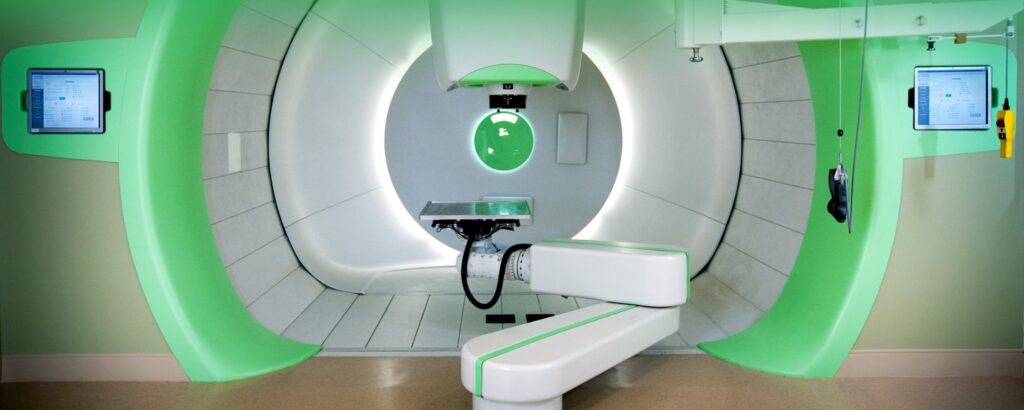
Proton Therapy
Proton Therapy and You
At Hampton Proton, your treatment is personalized. Your care team—including your radiation oncologist, medical physicist, dosimetrist, and radiation therapists—works together to design a plan tailored specifically to your diagnosis and anatomy.
We use advanced treatment-planning software and state-of-the-art proton therapy technology to deliver radiation with precision, while supporting you emotionally and physically through every step of care.
How Proton Therapy Works
Protons behave differently than traditional X-ray radiation.
As they enter the body, protons slow down and release their maximum energy directly at the tumor, then stop.
This allows us to:
- Potentially reduce side effects during and after treatment
- Target the cancer with high accuracy
- Reduce radiation exposure to healthy tissue and organs
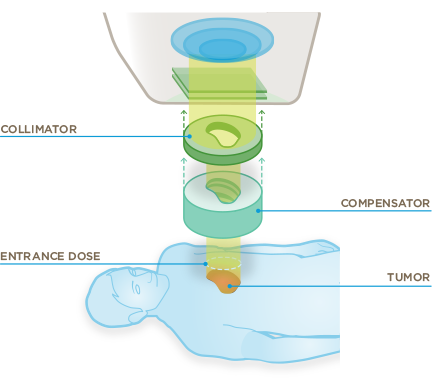
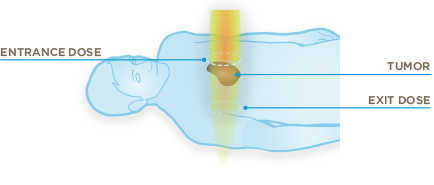
How Proton Therapy Treats Cancer
Proton therapy delivers precise radiation directly to the tumor while reducing exposure to surrounding healthy tissue. This advanced treatment allows us to target cancer with accuracy, lessen side effects, and support better long-term outcomes for patients.
Targeted Radiation
Proton therapy uses a precision-focused radiation beam to target and treat both benign and malignant tumors. Unnecessary radiation delivery to uninvolved normal tissues should be avoided whenever possible, and proton beam radiation allows for the maximal sparing of normal tissues. Unlike traditional radiation, which has a more generalized path that sends radiation through the tumor, proton radiation utilizes specific frequencies to help dial in the intended point of treatment. This creates a more targeted radiation that allows physicians the ability to focus higher levels of radiation directly on the tumor. The result spares more healthy cells, tissue and organs from radiation, which can significantly reduce side effects and treatment discomfort.3-4, 6-8, 15
History of Proton Therapy
Though proton therapy may seem relatively new, the idea of utilizing energetic protons as a treatment for cancer was first published by scientist Robert R. Wilson in 1946. Early treatments were performed at nuclear physics facilities, such as the Harvard Cyclotron Laboratory, and eventually gave way to the first hospital-based proton therapy center in 1990. Since then, over 45 proton cancer treatment centers have been established in the United States. Hampton University Proton Cancer Institute (Hampton Proton) was the eighth center to rise to prominence and was once the largest free-standing facility of its kind in the world.
Based on its exacting treatment focus, proton radiation has continued to be used as an effective treatment for cancer. With the ability to target tumors with greater precision, proton therapy allows physicians to treat cancerous areas more aggressively with less risk to healthy tissue and organs. Because of this, patients often experience limited side effects and complications.3-4, 6-8, 15 Proton therapy is most popularly used in the treatment of head and neck, brain, and prostate cancer, but growing results from its application for other cancer types, including breast, lung, GI and more, have continued to prove positive.3-15, 17-24
Today, over 300,000 people worldwide have received proton therapy, a number that is anticipated to grow larger and faster as more and more proton therapy centers continue to open their doors within the next several years. As one of the first proton therapy centers, Hampton Proton remains a stalwart of this evolving and innovative treatment type. Paired with our dedication to research and patient comfort and recovery, we strive to remain at the forefront of both cancer and patient care.